Week 1: The Language of Leaves, Stems, and Roots
Learning Vegetative Morphology
Step outside and look at the nearest patch of vegetation. At first, it may appear to be a nearly continuous field of green. Look longer, though, and that background begins to break apart.
One plant has leaves paired across from each other. Another has a single leaf at each point along its stem. Some leaves are smooth-edged, while others are toothed, lobed, hairy, waxy, or rolled underneath. What first looked like an anonymous patch of green becomes a collection of individuals, each with its own structure and strategy.
Learning to notice those differences is where my study of systematic botany began.
During the first week of class, I was introduced to vegetative morphology: the study of roots, stems, leaves, and other non-reproductive plant structures. The vocabulary initially feels like a new language, but each term gives us a more precise way to observe a plant.
That precision matters. Before we can identify a species, follow a dichotomous key, or understand how plants are related, we need to describe what is actually in front of us.
Roots
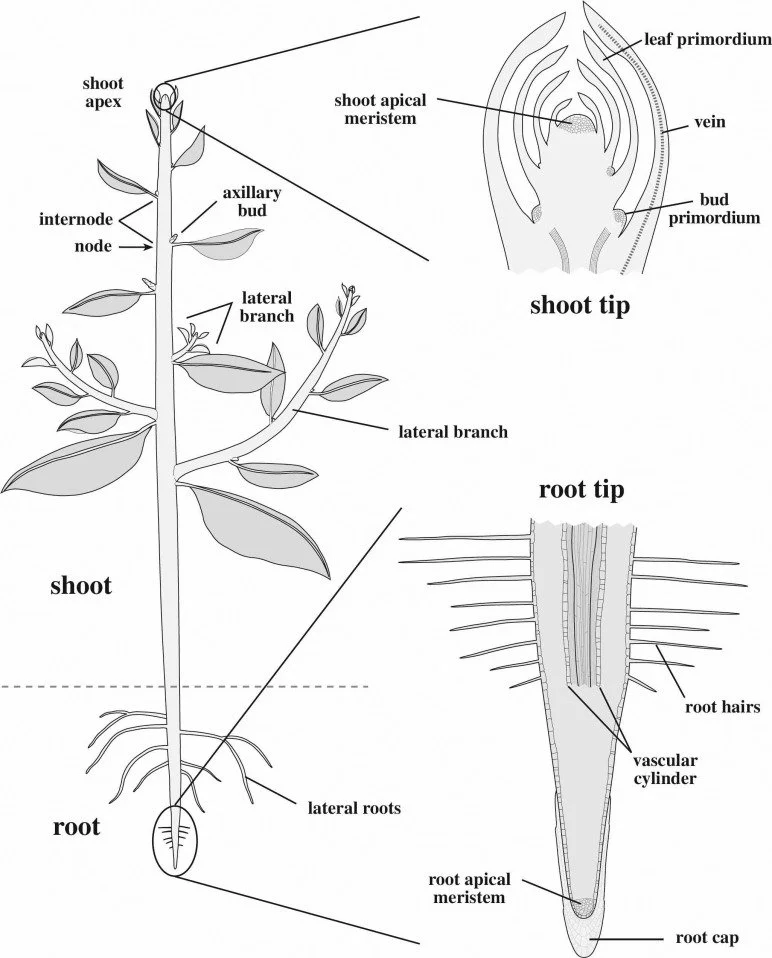
Roots commonly perform several jobs. They anchor a plant, absorb water and dissolved nutrients, store energy, and help some plants survive from one growing season to the next. Roots may also allow a plant to spread vegetatively and produce new shoots.
Although roots are often underground, location alone does not define them. Some plants produce aerial or exposed roots. To distinguish a true root from a buried stem, botanists look at its structure. Roots lack the nodes, buds, leaves, and leaf scars found on stems.
Three useful root categories are:
Taproot system: One dominant primary root grows downward and produces smaller lateral roots.
Fibrous root system: Numerous slender roots of similar size spread through the soil. This pattern is common among grasses and sedges.
Adventitious roots: Roots develop from a stem, leaf, or another location outside the original primary root system.
These are useful patterns, but living plants do not always fit perfectly into simple categories. Root architecture can change with species, age, soil conditions, moisture, disturbance, and available space.
A plant growing in shallow, frozen, compacted, or saturated ground may develop very differently from the same species growing in deep, well-drained soil. Morphology is therefore not just a set of labels. It is evidence of how a plant occupies its environment.
[Image] Photograph or sketch examples of a taproot, fibrous roots, and adventitious roots side by side.
When an Underground Structure Is Actually a Stem
One of my most important lessons this week was that an underground structure is not necessarily a root.
Stems can grow beneath the soil, store energy, and produce roots of their own. The clues are the presence of nodes, buds, reduced leaves, leaf scars, or new shoots. These structures reveal the organ’s identity even when its location is misleading.
A rhizome is a horizontal underground stem. It can produce roots and shoots at its nodes, allowing the plant to spread and persist. Rhizomes occur in many grasses and ferns and are especially important for perennial plants that must survive long winters or recurring disturbance.
A stolon, sometimes called a runner, grows horizontally along or near the soil surface. When it roots and produces shoots at a node, it can establish another plant.
Other modified shoots specialize in storage:
A bulb has a short stem surrounded by fleshy storage leaves, as in an onion.
A corm is a short, swollen, upright underground stem covered by dry, reduced leaves or leaf bases.
A stem tuber is a swollen storage portion of a stem or rhizome. A potato is the familiar example: each “eye” is a bud associated with a node.
The broader term tuber can also describe swollen storage structures derived from roots, so it is important to determine which organ has been modified rather than relying on appearance alone.
This distinction has practical consequences. Correctly identifying a rhizome, root, bulb, or corm helps explain how a plant stores resources, spreads, survives winter, and responds when its aboveground growth is damaged.
Stems: Reading a Plant’s Framework
A stem supports and positions leaves and reproductive structures. Its vascular tissues also move water, minerals, sugars, and other substances between different parts of the plant.
Two basic landmarks make stems easier to read:
A node is a point where a leaf, bud, or branch attaches.
An internode is the segment between two nodes.
Stems also reveal a plant’s growth form. A plant may be erect, prostrate, creeping, or tufted. It may have an obvious leafy stem or appear almost stemless, with leaves crowded near its base.
These differences are especially helpful when identifying plants outside the flowering season. In Interior Alaska, where the visible growing season is compressed, persistent stems, buds, scars, and growth forms may provide useful clues before flowers appear or after they disappear.
Leaves
Leaves are the primary photosynthetic organs of most vascular plants, but they are also among the most useful structures for identification.
A typical leaf may include:
the blade or lamina, its broad surface;
the petiole, the stalk attaching the blade to the stem;
the midvein, the principal vein running through the blade;
the base and apex;
and, in some species, stipules at the base of the petiole.
The upper side of a leaf is its adaxial surface. The lower side is its abaxial surface. Those surfaces may differ in color, texture, hairs, glands, or other features, so examining only the top of a leaf can mean missing an important identification clue.
Leaf arrangement
Leaf arrangement describes how leaves are positioned along a stem.
Alternate: One leaf occurs at each node.
Opposite: Two leaves occur at the same node, across from one another.
Whorled: Three or more leaves occur at one node.
Basal rosette: Leaves are crowded near the plant’s base.
This is one of the quickest patterns to observe without damaging a plant.
Simple and compound leaves
A simple leaf has one blade, although that blade may still be toothed or deeply lobed.
A compound leaf is divided into separate units called leaflets. The most reliable way to distinguish a leaf from a leaflet is to examine where it joins the supporting axis. A true leaf has an axillary bud at its base; an individual leaflet does not.
This small detail prevents a common identification mistake. What appears to be an entire leafy branch may actually be one compound leaf.
Venation, margins, and surfaces
The pattern formed by veins is called venation.
Pinnate venation has one main midvein with smaller veins branching from it.
Palmate venation has several main veins spreading from a common point.
Parallel venation has major veins running alongside one another, a pattern common among monocots.
Leaf margins may be entire, serrate, crenate, lobed, ciliate, or otherwise modified. Surfaces may be smooth, waxy, glandular, rough, or covered with trichomes, the botanical term for plant hairs.
Learning these terms changes observation from “this leaf looks different” to a description another person can understand and test.
[Image]: labeled photograph showing the blade, petiole, midvein, margin, apex, base, and axillary bud.
Seeing Plants More Clearly
This week’s morphology work connects to a larger problem known as plant blindness.
Botanists James Wandersee and Elisabeth Schussler used this term for the tendency to overlook plants, underestimate their importance, or see them primarily as background for animal life. They argued that plants can be difficult for us to notice as individuals because they often grow close together, share similar colors, and move on timescales that do not readily attract human attention.
Sandra Knapp later complicated the idea by asking whether people are specifically blind to plants or inattentive to most organisms other than familiar vertebrates. Either way, the practical problem remains: a diverse living community can collapse in our perception into a single category called “green.”
Morphological vocabulary offers one way through that wall.
Once I know to look for nodes, buds, leaf arrangements, veins, margins, and surface textures, vegetation becomes harder to dismiss as scenery. Naming a structure directs my attention toward it. Drawing it requires me to slow down. Comparing it with another specimen reveals variation I would otherwise miss.
The terminology is not simply a collection of words to memorize. It is a set of tools for learning how to see.
Weekly challenge:
A Five-Minute Plant Observation
Choose one plant outdoors or indoors. Before trying to identify it, record what you can observe.
What is its overall growth form?
Are its leaves alternate, opposite, whorled, or basal?
Is each leaf simple or compound?
What kind of venation can you see?
How would you describe the margin, apex, base, and surfaces?
Can you locate a node, internode, and axillary bud?
Do you see evidence of a modified stem or adventitious roots?
What did you notice after five minutes that you missed during the first five seconds?
A photograph records the plant’s appearance. A labeled sketch records what you understood. Doing both provides a useful foundation for identification.
Week 1 Glossary: Vegetative Morphology
Vegetative Morphology
The study of the non-reproductive structures of plants, including roots, stems, and leaves.
Root
A plant organ that commonly anchors the plant, absorbs water and dissolved nutrients, stores resources, or supports vegetative spread. True roots lack nodes, leaves, and buds.
Root System
The underground portion of a plant responsible for anchoring the plant and absorbing water and nutrients.
Primary Root
The first root produced by the plant embryo. It may remain dominant or give rise to smaller lateral roots
Lateral Root
A secondary root that branches from another root.
Taproot
A root system with one dominant primary root that grows downward and produces smaller lateral roots.
Fibrous Root System
A root system made of many thin roots of similar size that spread outward through the soil.
Adventitious Root
A root that develops from a stem, leaf, or other non-root tissue.
Aerial Root
A root that grows entirely or partly above the soil.
Stem
The main structural axis of a plant that supports leaves and transports water, nutrients, and sugars.
Node
The point on a stem where leaves, buds, or branches attach.
Internode
The segment of stem located between two nodes.
Bud
An undeveloped shoot that may contain immature leaves, flowers, or both.
Leaf Scar
A mark left on a stem after a leaf falls away.
Rhizome
A horizontal underground stem that produces roots and shoots along its length.
Stolon
A horizontal stem that grows along the soil surface and can produce new plants at nodes.
Bulb
A short underground stem surrounded by fleshy, modified storage leaves, as in an onion.
Corm
A short, solid, swollen, upright underground stem used for storage. It is commonly covered by dry, reduced leaves or leaf bases.
Tuber
A swollen underground stem used for energy storage, such as a potato.
Leaf
The primary photosynthetic organ of most plants.
Petiole
The stalk that attaches a leaf blade to the stem.
Blade (Lamina)
The broad, flat portion of a leaf where photosynthesis primarily occurs.
Midvein
The central vein that runs through the middle of a leaf blade.
Leaf Base
The lower portion of a leaf blade where it joins the petiole or stem.
Leaf Apex
The tip or terminal end of a leaf blade.
Stipule
A leaf-like or scale-like appendage sometimes present at the base of a petiole.
Adaxial Surface
The upper surface of a leaf, facing toward the plant’s stem or axis.
Abaxial Surface
The lower or underside surface of a leaf, facing away from the plant’s stem or axis.
Leaf Arrangement
The pattern in which leaves are positioned along a stem.
Alternate Leaves
A leaf arrangement where a single leaf grows at each node.
Opposite Leaves
A leaf arrangement where two leaves grow from the same node on opposite sides of the stem.
Basal Rosette
A circular or clustered arrangement of leaves located at or near the plant’s base
Whorled Leaves
A leaf arrangement where three or more leaves grow from the same node.
Simple Leaf
A leaf with one continuous blade. The blade may be toothed or deeply lobed but is not divided into separate leaflets.
Compound Leaf
A single leaf divided into two or more distinct leaflets.
Leaflet
One division of a compound leaf. A leaflet resembles a small leaf but does not have an axillary bud at its base.
Axillary Bud
A bud located in the angle between a leaf and the stem; used to distinguish leaves from leaflets.
Venation
The arrangement and pattern of veins within a leaf blade.
Pinnate Venation
A venation pattern with one central vein and smaller branching veins.
Palmate Venation
A venation pattern where several main veins originate from a single point at the base of the leaf.
Parallel Venation
A venation pattern in which the principal veins run approximately parallel to one another.
Leaf Margin
The outer edge of a leaf blade.
Trichome
A hair or hair-like outgrowth of the plant epidermis.
Plant Blindness
A term introduced to describe the tendency to overlook plants, underestimate their importance, or perceive them primarily as background for animal life.
Plant Awareness Disparity
A term proposed by Kathryn Parsley to describe the disparity between how readily people notice plants and how readily they notice animals. It replaces a disability metaphor while retaining the focus on attention, knowledge, interest, and attitudes toward plants.
Further Reading
Knapp, S. (2019). “Are humans really blind to plants?” Plants, People, Planet, 1, 164–168. https://doi.org/10.1002/ppp3.36
Parsley, K. M. (2020). Plant awareness disparity: A case for renaming plant blindness. Plants, People, Planet, 2(6), 598–601. https://doi.org/10.1002/ppp3.10153
Wandersee, J. H., & Schussler, E. E. (2001). Toward a theory of plant blindness. Plant Science Bulletin, 47(1), 2–9.
